
The day Nicholas Way arrived at the front, September 21st, 1916, was unremarkable for the Canadian Scottish. Billeted in Albert, the Battalion had been out of the line for two weeks and was resting after suffering severely in the Battle of Mouquet Farm. The only noticeable event during the day was the sighting of tanks for the first time.
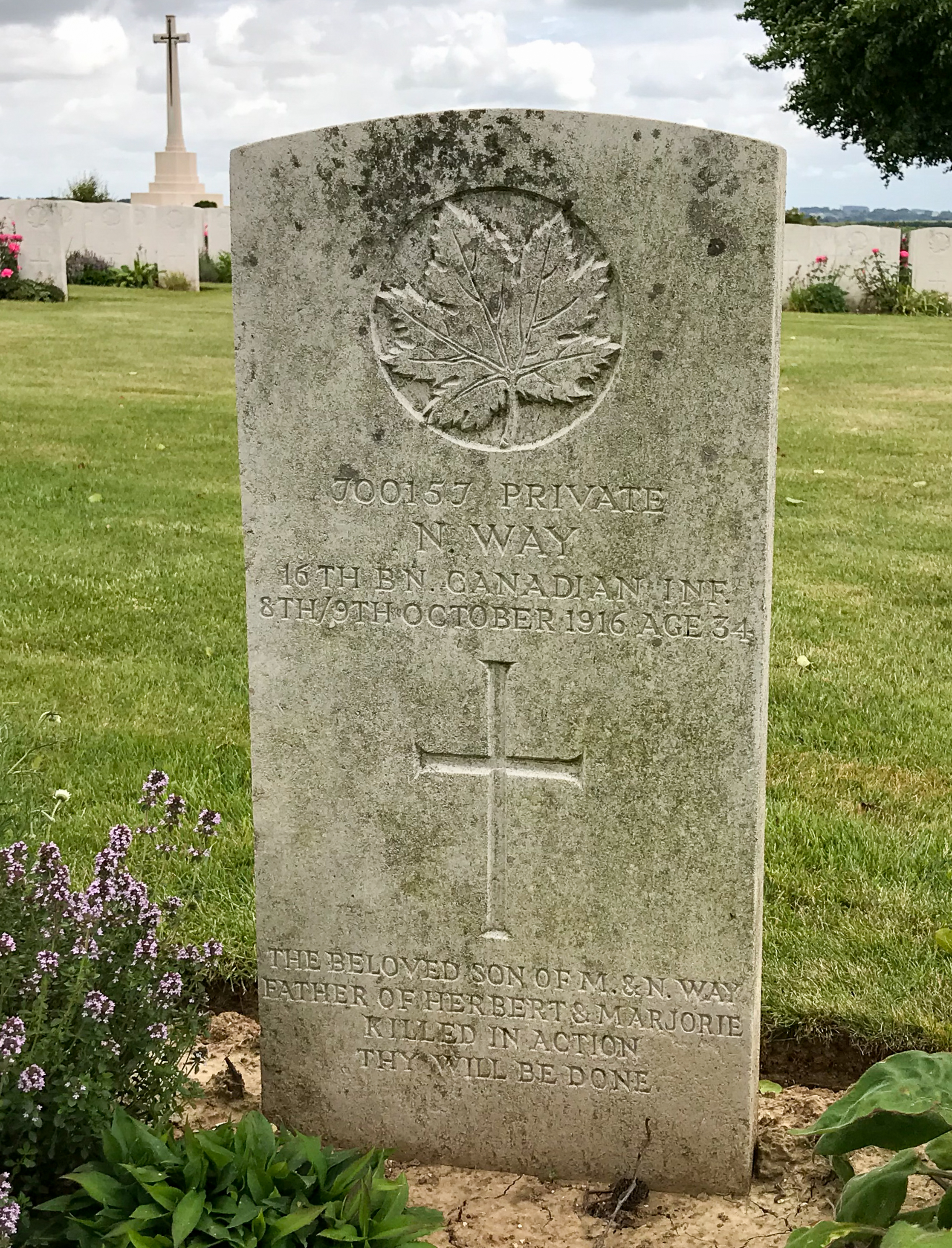
Adanac Cemetery
Born in St. Ives, Cornwall, Nicholas was one of five children, with three sisters and a brother. He shared his name with his father who was an Engineman for the Great Western Railway, where he worked for more than thirty years.
Nicholas came to Canada in 1913, settling in Winnipeg where he took a job as a milk man for the well established Crescent Creamery Company. It was, no doubt, a dramatic change for a man who had been a hairdresser for more than ten years. It’s not known what drew him to Winnipeg – what prompted him to leave behind his wife, Lilian, whom he had married in 1906, and his two young children – Marjorie and Herbert.
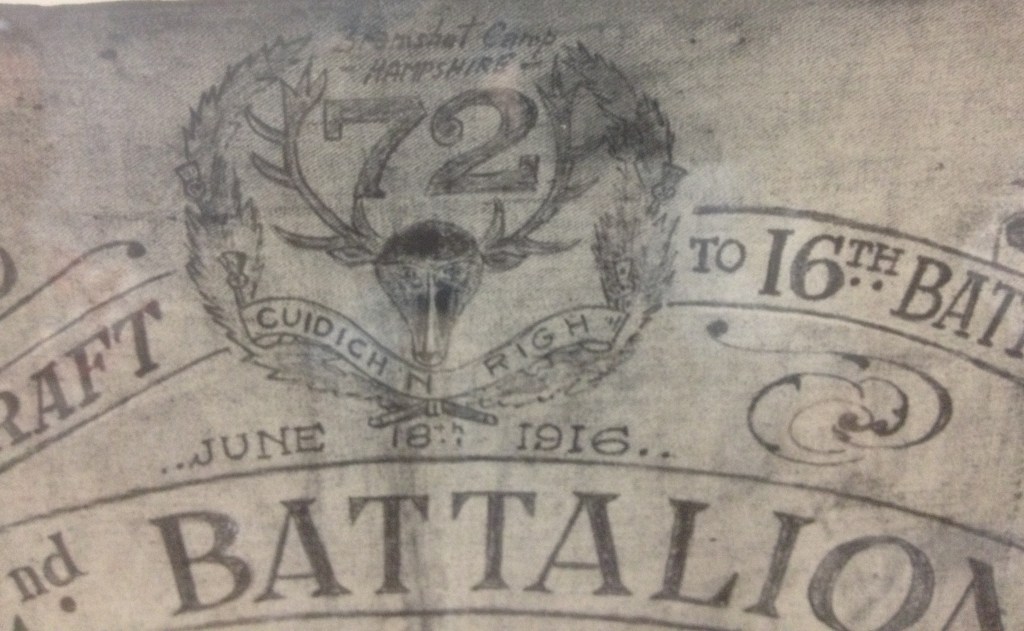
Nicholas spent his first year in Winnipeg sharing an apartment with three other drivers from the dairy – two of whom also served during the War. In 1915 he enlisted with the 101st Battalion, Winnipeg Light Infantry, that was recruiting in Winnipeg in December and January. He departed for England in late June 1916, arriving two weeks later. After a short stay with a reserve battalion he was transferred to the Canadian Scottish, heading to France at the end of August and arriving in the field five days before the battalion was called on to support an attack on Kenora Trench.
While deploying just two companies for mopping up detail, the attack on Kenora Trench eventually drew in most of the Battalion in fierce fighting for little gain. Over twenty-four hours the Battalion suffered 116 casualties of which 17 were killed.
A week later, on October 8th, the 16th was called upon to capture a German stronghold, the Regina Trench. Spread out over a 350 yard front the 16th attacked in four waves that quickly merged into one. In fierce fighting the Germans made a strong counter attack, forcing the Battalion to retire to its original line. It came out of the line late on the 9th, returning to Albert having suffered heavily. Just two weeks after arriving at the front, Nicholas Way was killed – he was thirty-five.
After Nicholas left for Winnipeg in 1913 his wife Lilian moved away from Plymouth eventually settling in Liskeard, Cornwall. In 1917 Mary Way, Nicholas’s mother, became the guardian for his two children.

 Perspectives On The Front
Leave a comment