
It shouldn’t come as a surprise that I am a data geek. Not a technical data geek like some of my former colleagues and friends in the cybersecurity space, but an information junky; the type of person who hoards information – in my case archival records, newspapers, periodicals and articles. . . electronically, of course – the people who clean out my basement when I move to the archive-in-the-sky won’t need to be concerned with feeding a landfill or building a bonfire.
I reflect on this because of the growing number of documents I have on my hard drive (and stored in the Cloud). While these documents are readily available online with the right search path, for one reason or another I want to possess a copy possess. A good and perhaps crazy example of this is the growing collection of court martial documents that I have.
Online Archival Records
One of the great things that archives around the world are doing is moving documents online so they’re more accessible. Generally, when accessing these through an archive’s site, these documents are made available at no charge. Some archives are farther down this past than others, although funding woes often limit an archive’s ability to digitize records forcing trade-offs have to be made. During Covid the British National Archives made the documents they had online freely available – previously they had charged for access to these – and they have maintained this approach since normalization; a huge plus for researchers of all types.
Library and Archives Canada have made it a priority to digitize records, particularly those relating to the First World War and the Canadian Expeditionary Force.
Finding Court Martial Documents in Library and Archives Canada
Court martial documents are an amazing resource in uncovering the story of soldiers at the front, and with a few exceptions the proceedings from the CEF court martials are available on line.
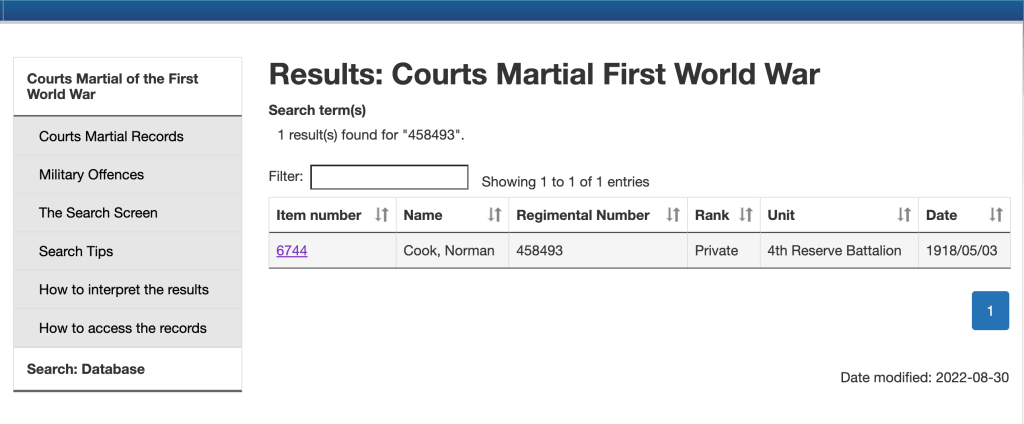
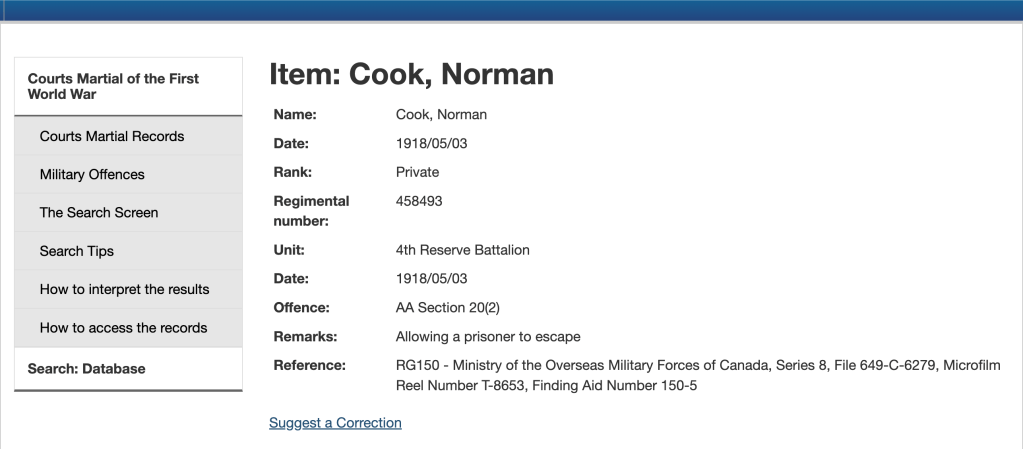
A typical journey in wanting to find and review a court martial proceeding starts, like so much else, with an entry in a service record or a battalion diary that references an offence by a particular soldier. A good example of this is the case of Sergeant Norman Cooke (or Cook, depending on the document) – regimental number #458493 – who enlisted with the 60th Battalion in August 1915. At the time of his offence he was serving with the 4th Canadian Reserve Battalion. Ironically, before the war Cook was a policeman. Sergeant (later Private) Cook, 32 years of age, arrived at the Front in February 1916. Two years later, in May 1918, a reference in his service record noted that he had been given 56 days of detention and forfeited 23 days of pay, plus a further 20 days awaiting trial.
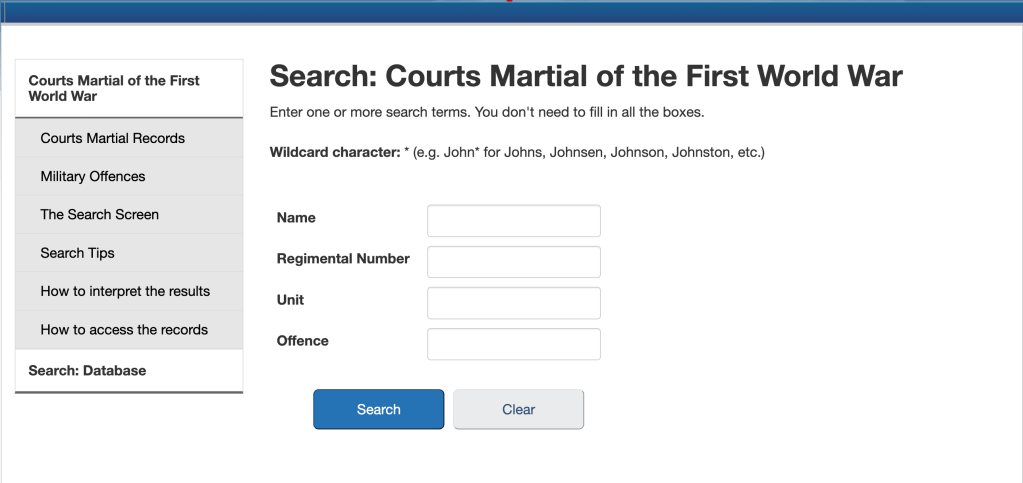
Library and Archives Canada (LAC) provides a very good tool for searching particular soldiers, offences and court martial proceedings, and providing a finding aid – a file reference in their holdings – to locate the file in their holdings – either physically or digitally. This page is found easily on the LAC website.
Accessing Court Martial Documents Online
Like a lot of archives around the world LAC has been outsourcing some of its records to third party organizations, such as Ancestry.com. There are different opinions whether this is the right thing to do. However, as national archives struggle to make their records more accessible while dealing with the interminable funding woes they need to look for new ways to fund the vital role they play. In providing some of their records to third parties LAC are not denying universal access to Canadians. If these records have been digitized they are still freely available online via the LAC web site. In many cases, however, partners like Ancestry.com are able to provide a more elegant organizational search for the records, making it easier to find relevant details, than can be provided by LAC with its existing resources.
Library and Archives Canada is a member of the Canadian Research Knowledge Network (CRKN) and it is to this organization that LAC turned to help move the court martial documents online. Working together, LAC provided the CRKN with funding to move some of its most highly used collections online, among them the court martial proceedings. The CRKN has digitized and stored online all of the microfilm rolls for court martial proceedings and has made them available on their website.
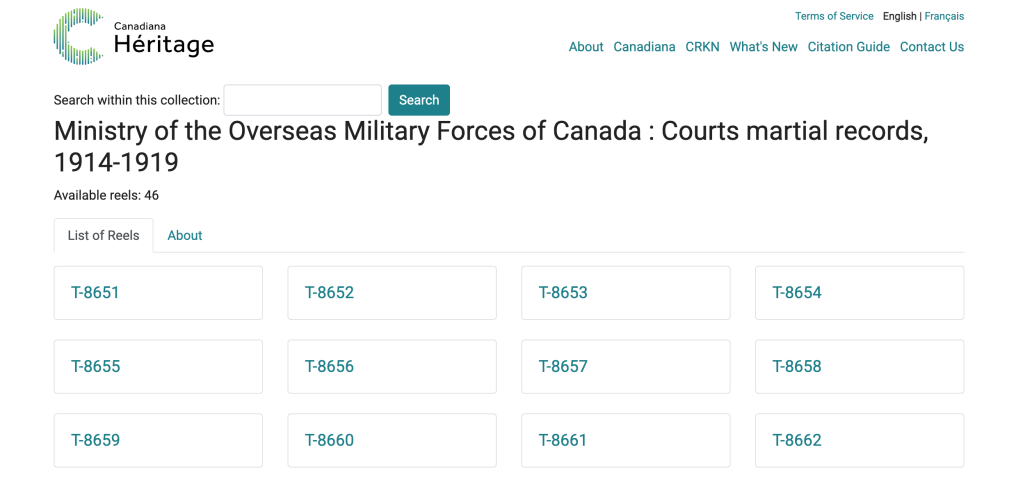
The challenge in finding the specific court martial docket for Cook, however, is that there is no search capability within a particular microfilm reel. The docket for Norman Cook is C-6279 – the opening docket on microfilm reel T-8653 is C-5 (it is found on image #3 of 5,489 images) and the final record is C-10050 (on image #5,475) . Without an effective way to search the reel it’s necessary to scroll or jump through the document (and the 5,489 pages) until docket C-6279 is located.
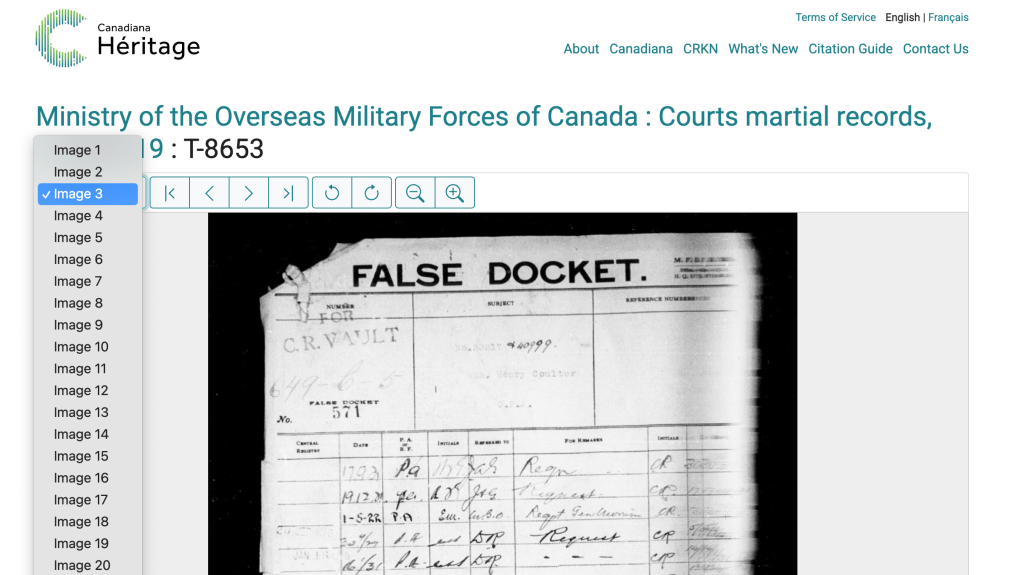
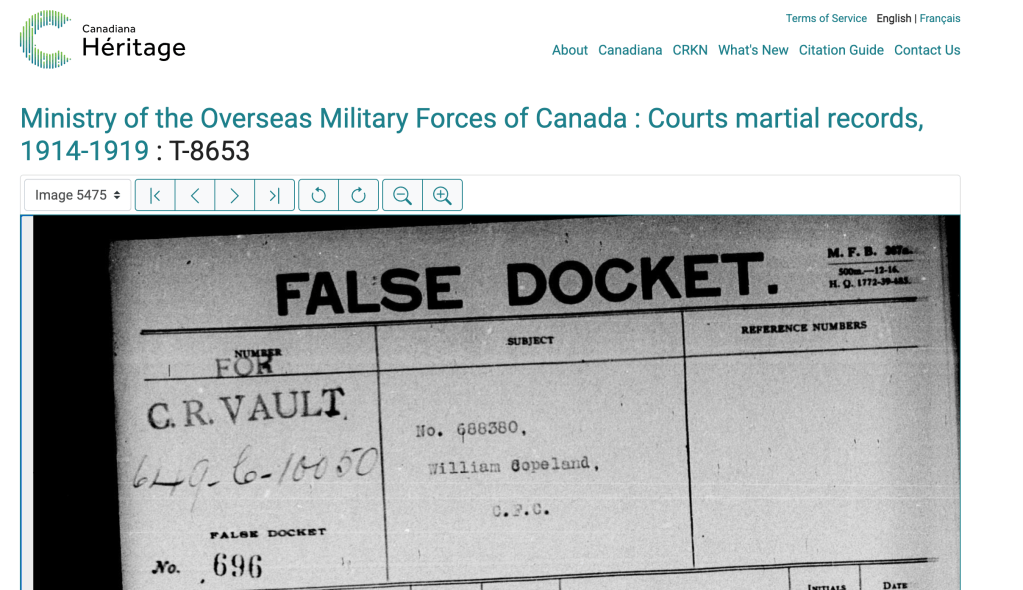
Finding the right docket in this way can take an inordinate amount of time since a court martial proceeding can vary in the number of pages. Moreover, the dockets are not sequential. As an example:
- the lead sheet for docket C-7147 is image #4474;
- the next lead sheet is for docket C-7158, and the image is #4492; and,
- the lead sheet after that is for docket C-7209, and the image is #4502.
Finding Court Martial Documents – Making the Job Easier
Although it is not well publicized, it is possible to download the entire digital version of the microfilm reel which makes it much easier to find and read the documents associated with a particular court martial proceeding. This is done using a third party tool endorsed by CRKN.
The tool – pdiiif – is a JavaScript library used to create PDF documents from IIIF Manifests. In simple terms, this means a person can download and save locally the digitized content of the entire microfilm reel as a PDF file. This is done simply by:
- Step 1 – pointing the tool (a website) to the URL of the desired Microfilm reel and making a minor edit to the target URL;
- Step 2 – providing the file name and location where the PDF will be stored on your computer, and generating the pdf;
- Step 3 – confirming the result.
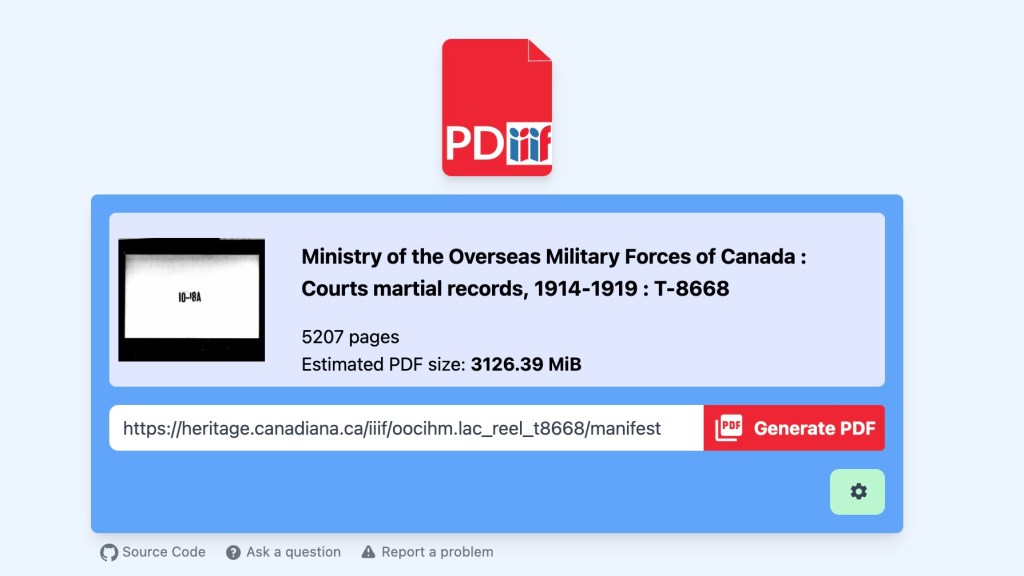
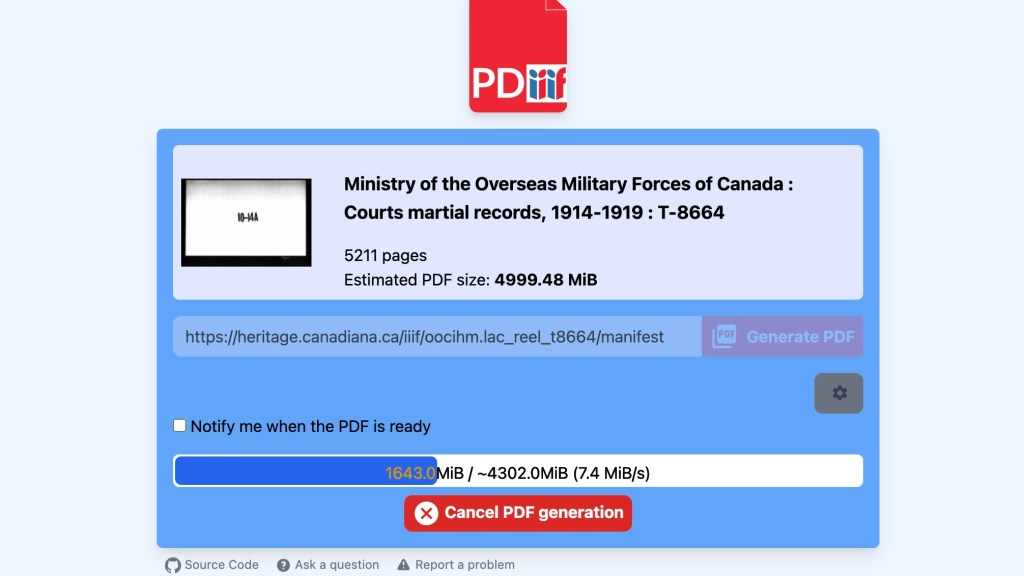
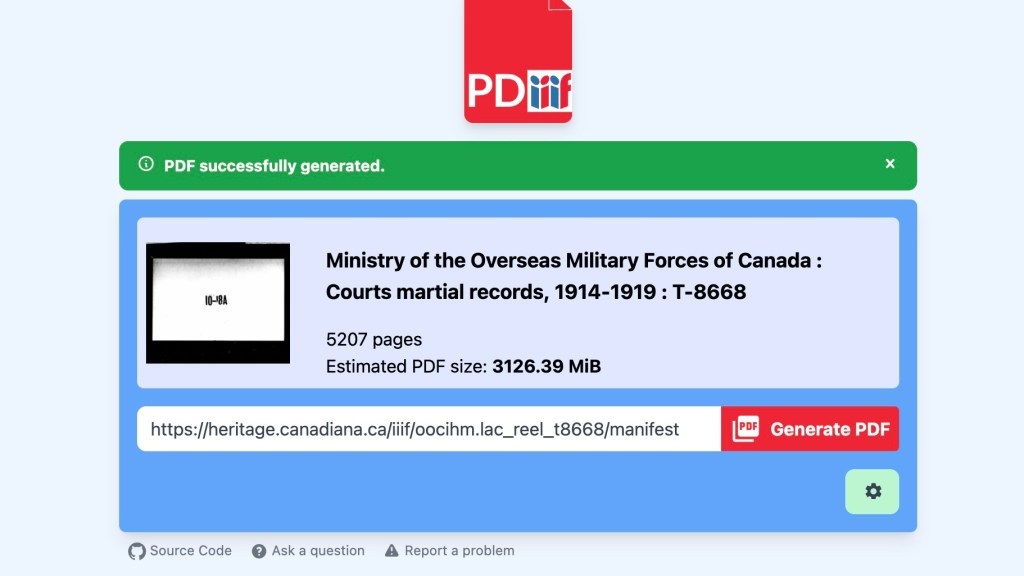
The Output: a locally stored copy of the microfilm reel
It is demonstrably easier and faster to find the docket for a particular court martial proceeding (ie: C-6279 for Private Norman Cook) by searching or scrolling through a locally stored PDF. It is also much easier to read the file (and for the amateur researcher the added advantage is potentially coming across some other fascinating stories).

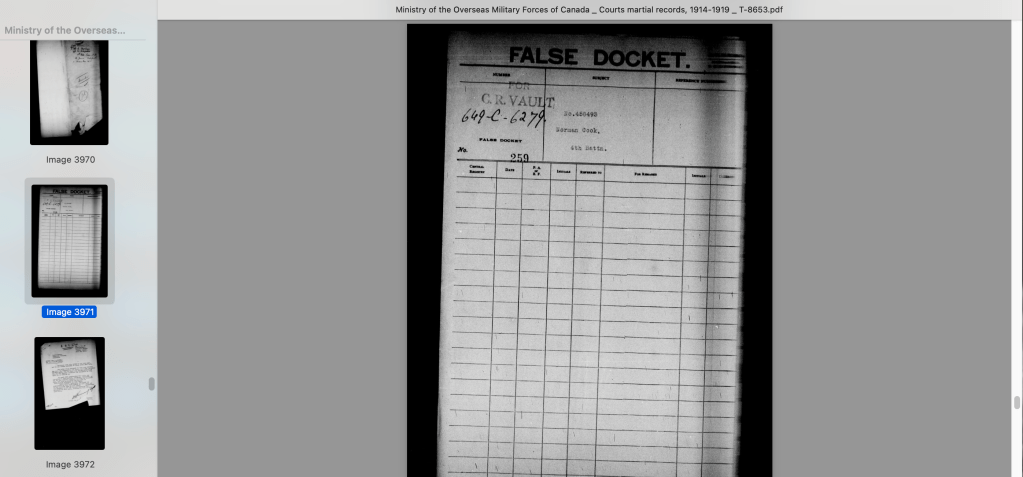
With the PDF file in hand, it is easy to quickly scroll through the document and find the relevant record for Norman Cook in less than a minute – locating it on image/page #3,971 of the 5,475 on the microfilm reel.
It is at this point that we circle back to my opening comment about being a data geek. Once I realized I could easily download hundreds and hundreds of court martial proceedings, and scroll through them at my leisure, I was just a very small step away from accumulating my own archive of all of the available court martial proceedings for the CEF. The only challenge with this is the same one encountered by any archive: with each file being anywhere from 2 to 3 gigabytes in size, Storage is King. But for an information junky like I am that is a small hurdle for the greater good.

 Perspectives On The Front
Leave a comment