
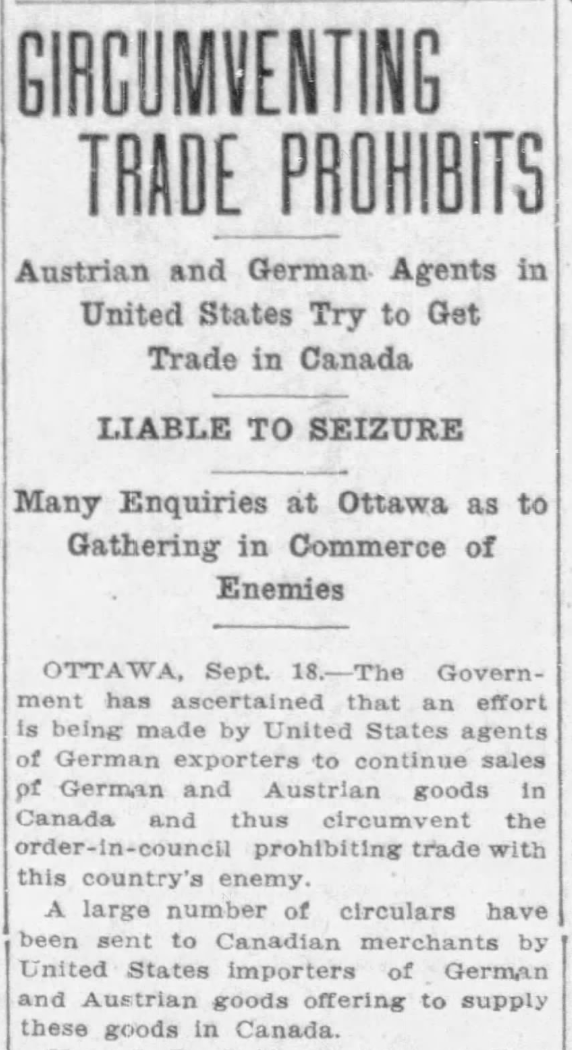
This is a very short item as I thought this article was interesting, as are many issues of Canada-US relations during the War. In the context of the current egregious US trade actions against Canada and others, there are many fascinating historical parallels. This brief article points to an interesting issue: the violation of Canadian laws by Americans is certainly not new, nor the need for Canada to develop its manufacturing base and diversify beyond the United States.
I have never been shy about my dislike of the United States (bar, U.S. College Football), nor distaste with American nationalism – I have never liked what the U.S. stands for. . . although, as the saying goes, “some of my best friends are American” (not actually true, but I do have a number of friends who are American).
The United States puts the United States first, regardless of any moral principles at stake. If it’s good for the U.S., it’s good. Of course, the recent trade dispute is not good for the U.S., but that raises an entirely different issue.
In the opening days of the War, global trade was turned upside down. Britain, and by extension Canada, passed Orders-in-Council prohibiting trade with Germany and Austria. On August 8th the Canadian Government issued a proclamation warning Canadians that they must discontinue trade with the enemy. At the same time, the proclamation disclosed a long list of items prohibited from being exported to any country other than Britain. This list included arms of all kinds, powder and explosives, projectiles, guns and military equipment, petroleum, saddles, draught and pack animals, and much more.
The response of the British government was one of sympathy to the United States, recognizing that it was “impossible to prevent loss in the German market to American traders in contraband products, but the loss on individual cargoes would be refunded by Great Britain if she could possibly do so.” On the other hand, where markets in Germany were lost, new ones were found. American manufacturers found vast new opportunities in the South American market, replacing Germany’s South American trade.
But merchants in the United States and Canada also looked for ways to circumvent the export controls. Within a month of the outbreak of war it became apparent to the Canadian Government that U.S. agents for German exports were making a concerted effort to circumvent the Order-in-Council prohibiting Canadian trade with Germany by acting as intermediaries for the trade of these goods – importing German goods to the United States and selling them to Canadian manufacturers, making money for themselves and violating Canadian law.
In a prescient observation for today’s crisis, Canada’s Minister of Trade and Commerce at the time, Sir George Foster, noted that “the present effort of the war will be to permanently replace with Canadian-made goods many which have hitherto been purchased outside of Canada.”

 Perspectives On The Front
Leave a comment