One of the more amazing archival collections that Canada has – of which many Canadians, even those with an interest in military history are probably unaware – is the archive at the Canadian War Museum. Even as a student of history, with the hours I have spent in the National Archives I was, until recently, blissfully ignorant of the collection at the War Museum.
At the same time as I’ve started to explore their catalogue, I’ve begun spending time reading through some of the First World War memoirs and correspondence in their collection. I began by compiling an inventory of the letters so I could readily prioritize those I wanted to review.
During a recent visit, I requested that a collection belonging to Private Hall B. Kirkland be set aside for review — individual letters written to his father, mother, and sister. As an aside, one of the most striking observations about some of the correspondence in general is the sheer frequency of the letters sent by some of the soldiers. In one collection — that of Private William Roy Gullen — he writes to his wife and children on an almost weekly basis between July 1916 and May 1917. The collection of 113 letters abruptly ends in May 1917, when he was declared “missing.”
Private Hal Kirkland was a student from the Ottawa Valley who enlisted early in the War, in April 1915, when he was just 19. He had previously been a member of the militia, with the 42nd Lanark and Renfrew Regiment, but signed up with the 38th Overseas Battalion, and was part of the first reinforcing draft from that battalion to the Princess Patricia’s Canadian Light Infantry in May, 1915
Over the course of his service, he was wounded twice – in the face and later in the left hand – but survived the war, going on to be the postmaster in his hometown of Almonte, Ontario – a post he took over from his father in 1934. In his retirement he was a prolific writer, publishing stories primarily of local interest in newspapers and magazines.
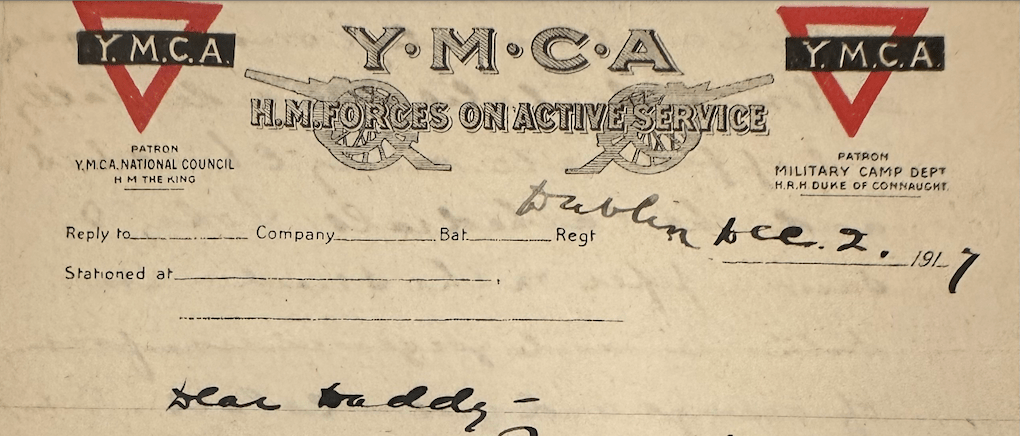
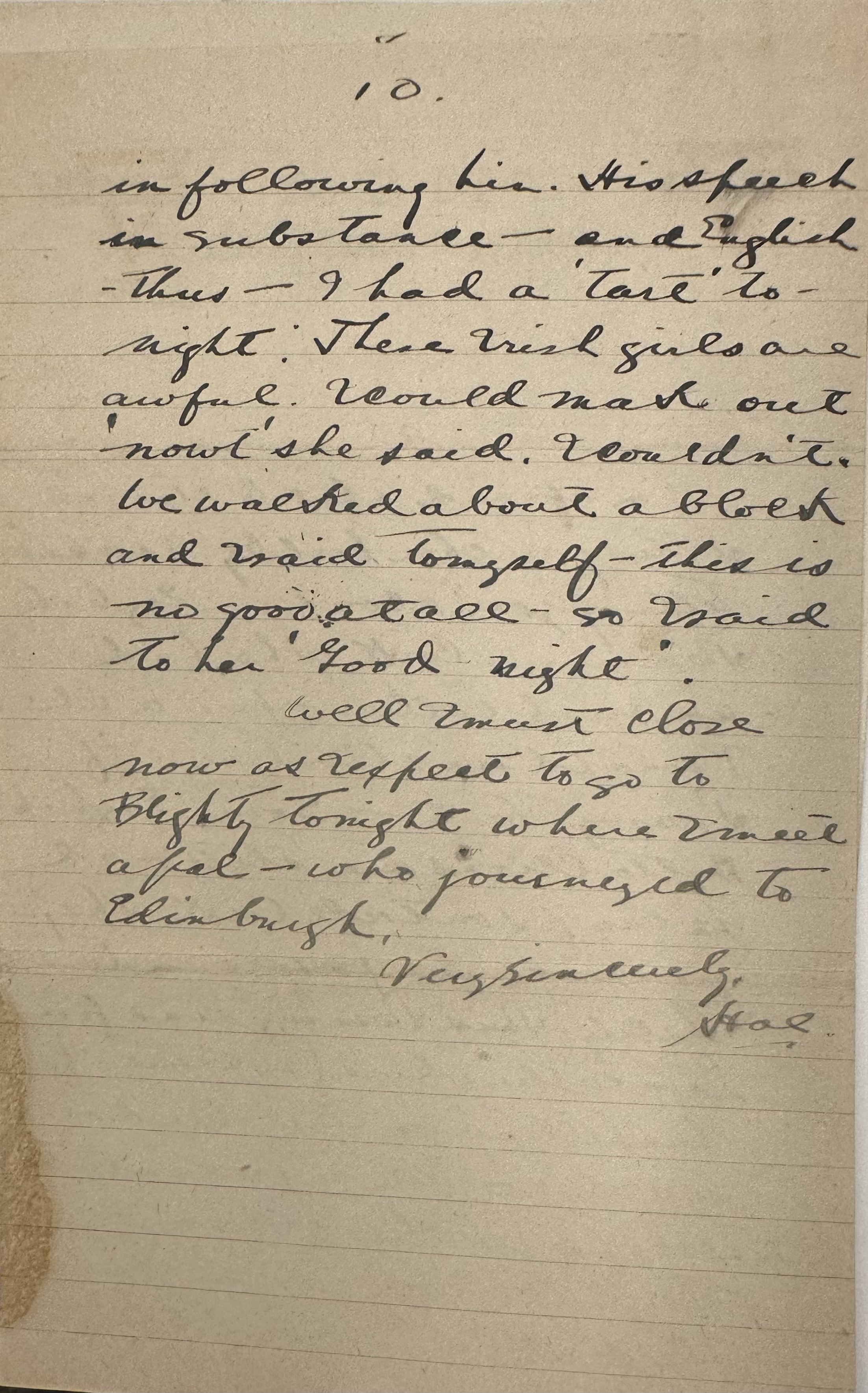
In December 1917 Private Kirkland visited Ireland and wrote, what I found to be, a fascinating letter home to his father, recounting tales of the local people he met, as well as those of some other soldiers. Unfortunately pages 6 and 7 of the letter are missing, but the surviving portion contain a series of colourful, and occasionally poignant, observations.
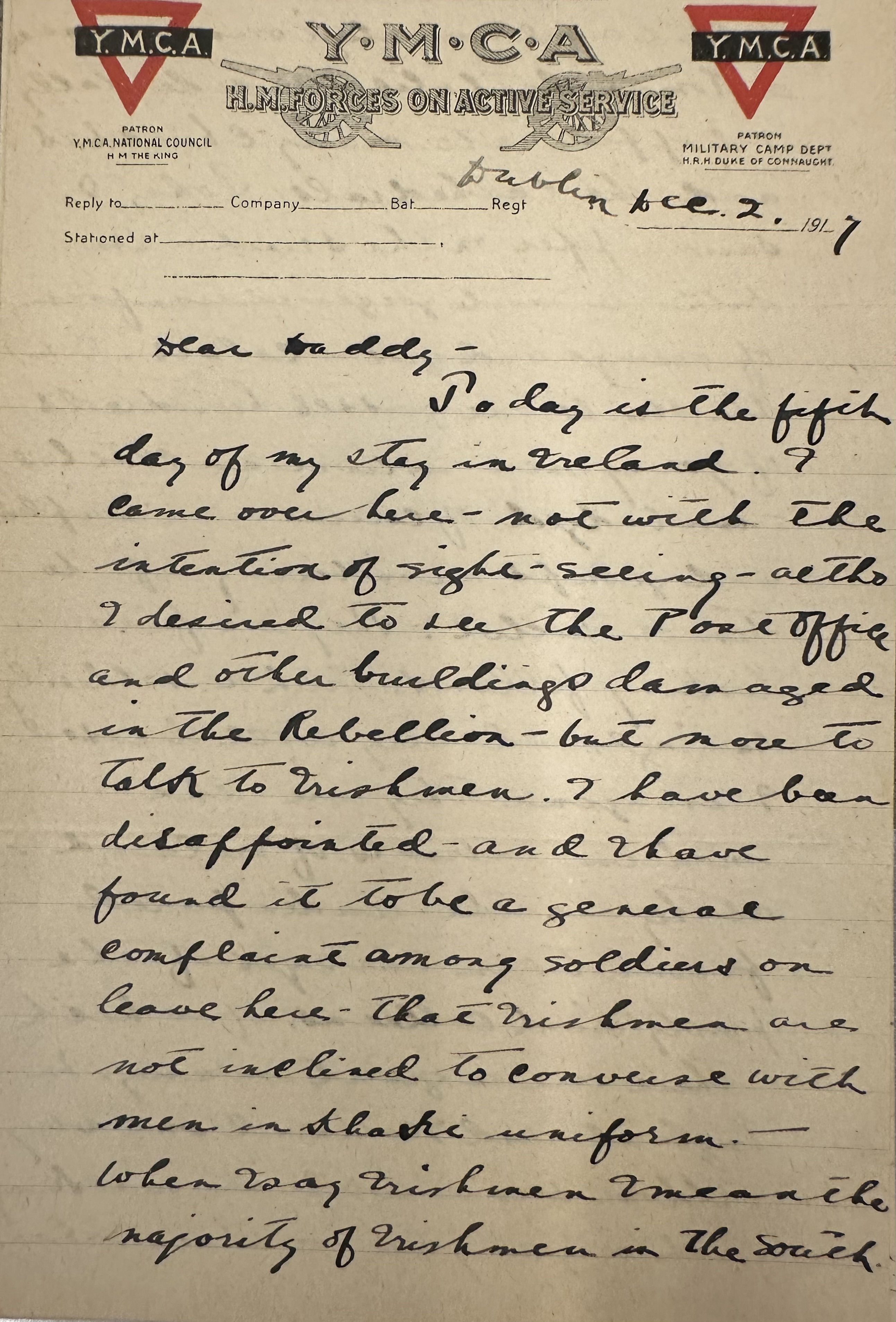
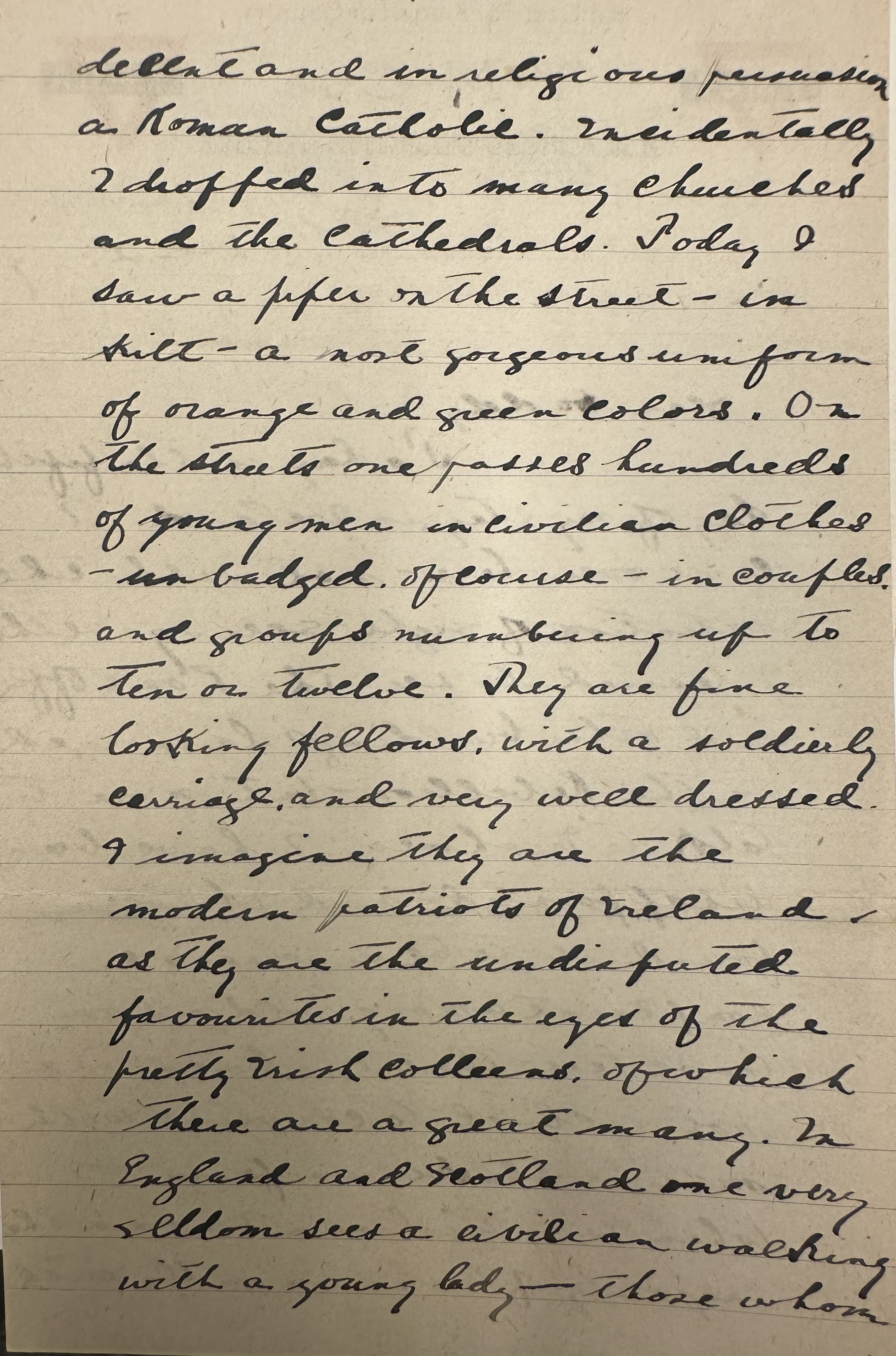
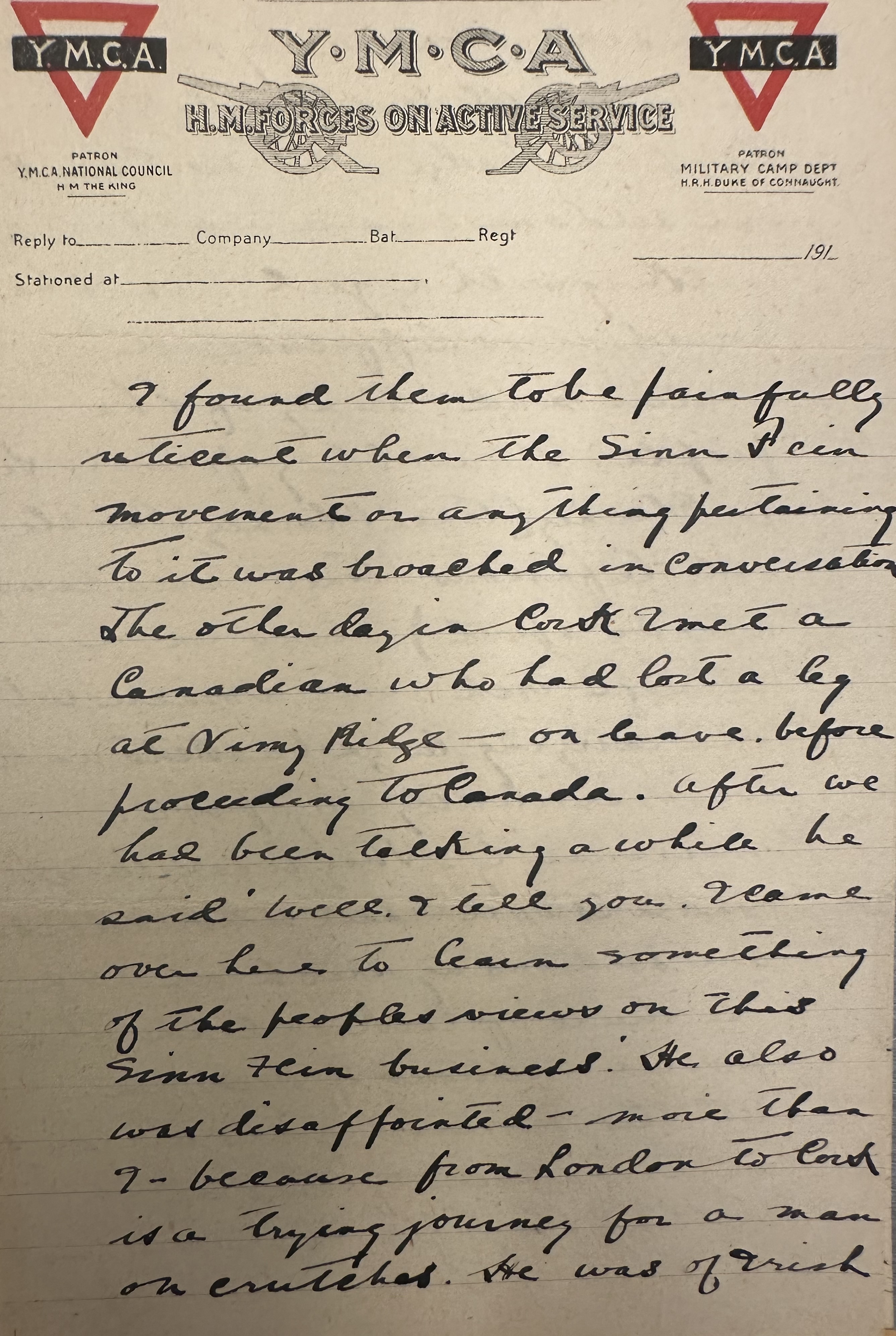
With a little help from AI, I transcribed the pages of hs letter below, to provide a fascinating, short read.
Dec. 2, 1917
Dear Daddy —
Today is the fifth day of my stay in Ireland. I came over here not with the intention of sight-seeing – altho I desired to see the Post Office and other buildings damaged in the Rebellion – but more to talk to Irishmen. I have been disappointed – and I have found it to be a general complaint among soldiers on leave here – that Irishmen are not inclined to converse with men in khaki uniform.
When I say Irishmen I mean the majority of Irishmen in the south – (pg 2) decent and in religious persuasion a Roman Catholic. Incidentally I dropped into many churches and the Cathedral. Today I saw a piper in the street — in kilt — a most gorgeous uniform of orange and green colors. On the streets one passes hundreds of young men in civilian clothes — unbadged, of course — in couples and groups numbering up to ten or twelve. They are fine looking fellows, with a soldierly carriage, and very well dressed.
I imagine they are the modern patriots of Ireland, as they are the undisputed favourites in the eyes of the pretty Irish colleens, of which there are a great many. In England and Scotland one very seldom sees a civilian walking with a young lady — those whom (pg3) I found them to be painfully reticent when the Sinn Fein movement or anything pertaining to it was broached in conversation.
The other day in Cork I met a Canadian who had lost a leg at Vimy Ridge – on leave, before proceeding to Canada. After we had been talking a while he said “Well, I tell you, I came over here to learn something of the peoples views on this Sinn Fein business.” He also was disappointed – more than I because from London to Cork is a trying journey for a man on crutches. He was of Irish descent.
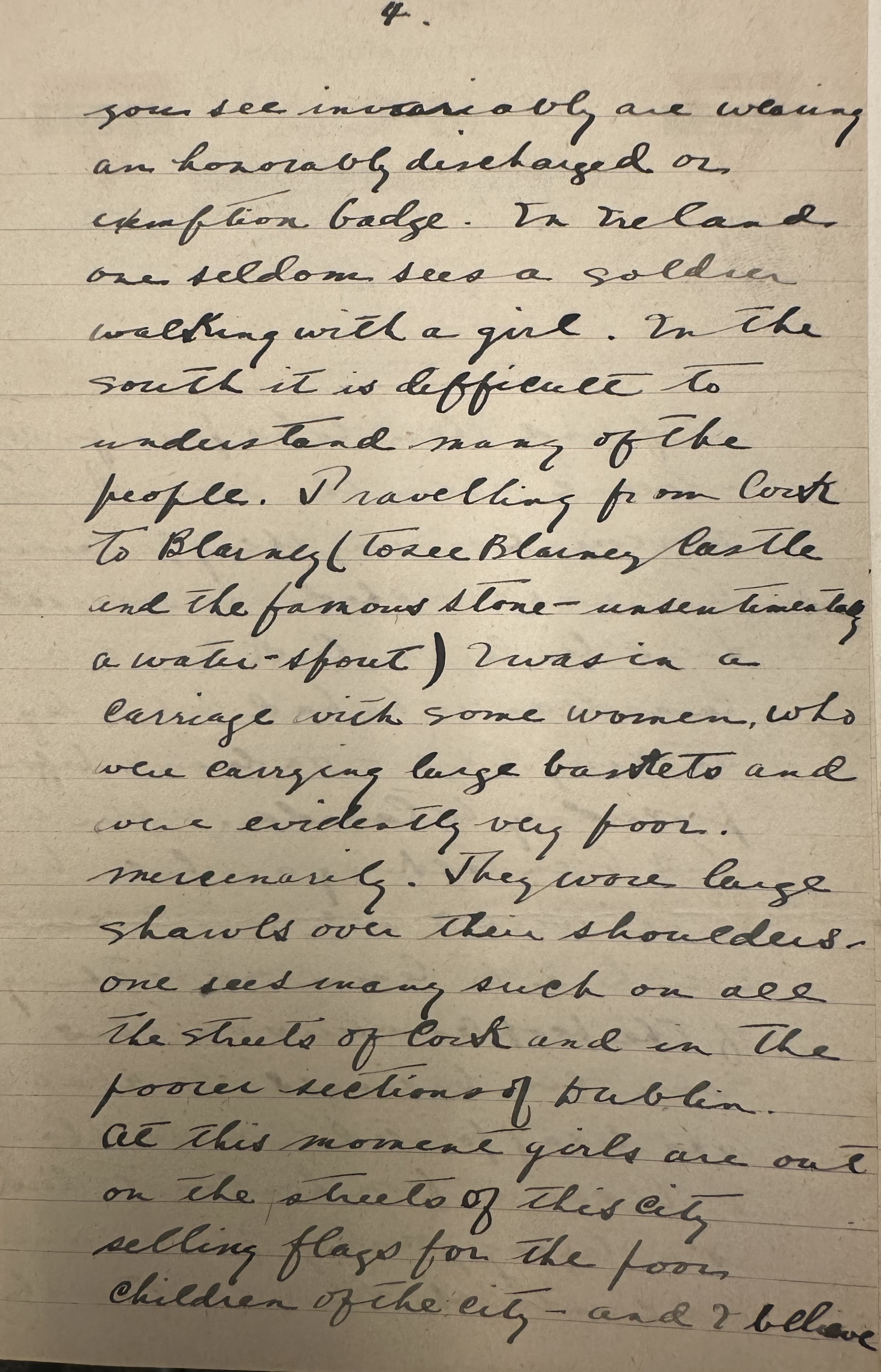
The men (pg 4) you see invariably are wearing an honorable discharged or exemption badge. In Ireland one seldom sees a soldier walking with a girl. In the south it is difficult to understand many of the people. Travelling from Cork to Blarney (where Blarney Castle and the famous stone — essentially a water-spout) I was in a carriage with some women, who were carrying large baskets and were evidently very poor. Moreover, they wore large shawls over their shoulders — one sees many such on all the streets of Cork and in the poorer sections of Dublin.
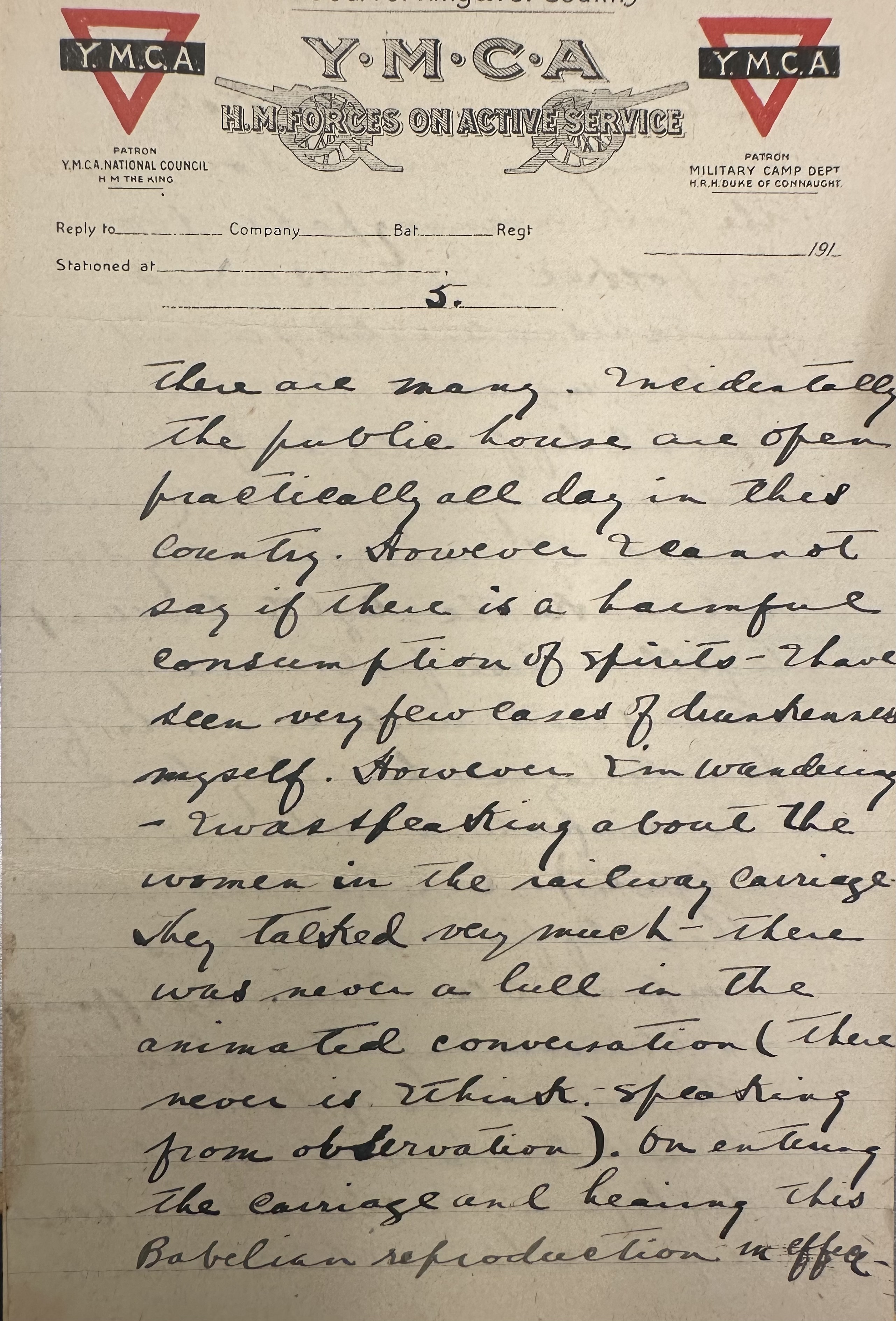
At this moment girls are out on the streets of this city selling flags for the poor children of the city — and I believe there are many. (pg 5) Incidentally the public houses are open practically all day in this country. However I cannot say if there is a harmful consumption of spirits – I have seen very few cases of drunkenness myself. However I’m wandering – I was speaking about the women in the railway carriage. They talked very much – there was never a lull in the animated conversation (there never is I think, speaking from observation). On entering the carriage and hearing this babelian reproduction in effect. I thought this will be interesting—very likely amusing. (Pg 6) I sat down – took the Cork morning paper from my pocket and assumed a quite disinterested pose. I cocked my ears. I certainly expected difficulty in following this running loquence (I believe in society men generally do not make the slightest attempt to follow these fast running streams and undercurrents of female logic when they have the misfortune to be in such a boat)—but it was more than difficult—it was impossible. I was disappointed, so turned my thoughts to the criticisms of Lord Lansdowne’s letter of the day before. Milk is 8d.—16 cents—a quart here. I have seen
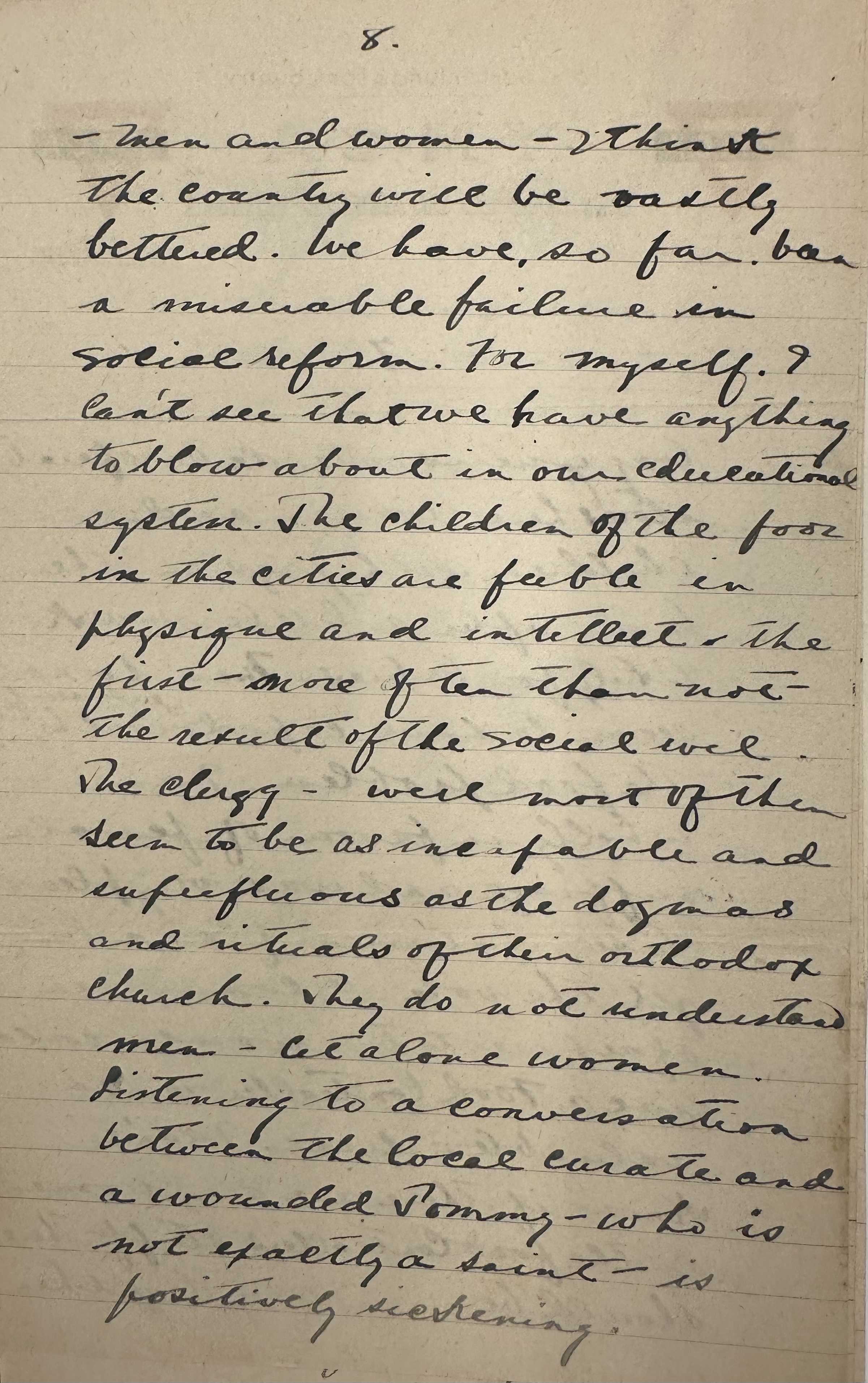
(Pg 7) Cozy queues outside co-operative stores here—women and children with jugs in their hand—after a little milk—likely for babies. Men do not seem to have coped very successfully with the food problem. I am wholly in favour of female suffrage and was very pleased to see the women of Canada get the vote. A committee of representative women could give a Food Controller much valuable advice. I don’t know if there are any women on the Food Controller’s staff—there should be. Working together (Pg 8) men and women — I think the country will be vastly bettered. We have, so far, been a miserable failure in social reform. For myself, I can’t see that we have anything to blow about in our educational system. The children of the poor in the cities are feeble in physique and intellect, the first more often than not the result of the social evil. The clergy — well most of them seem to be as ineffectual and superfluous as the dogmas and rituals of their orthodox church. They do not understand men – let alone women. Listening to a conversation between the local curate and a wounded Tommy – who is not exactly a saint – is positively sickening.
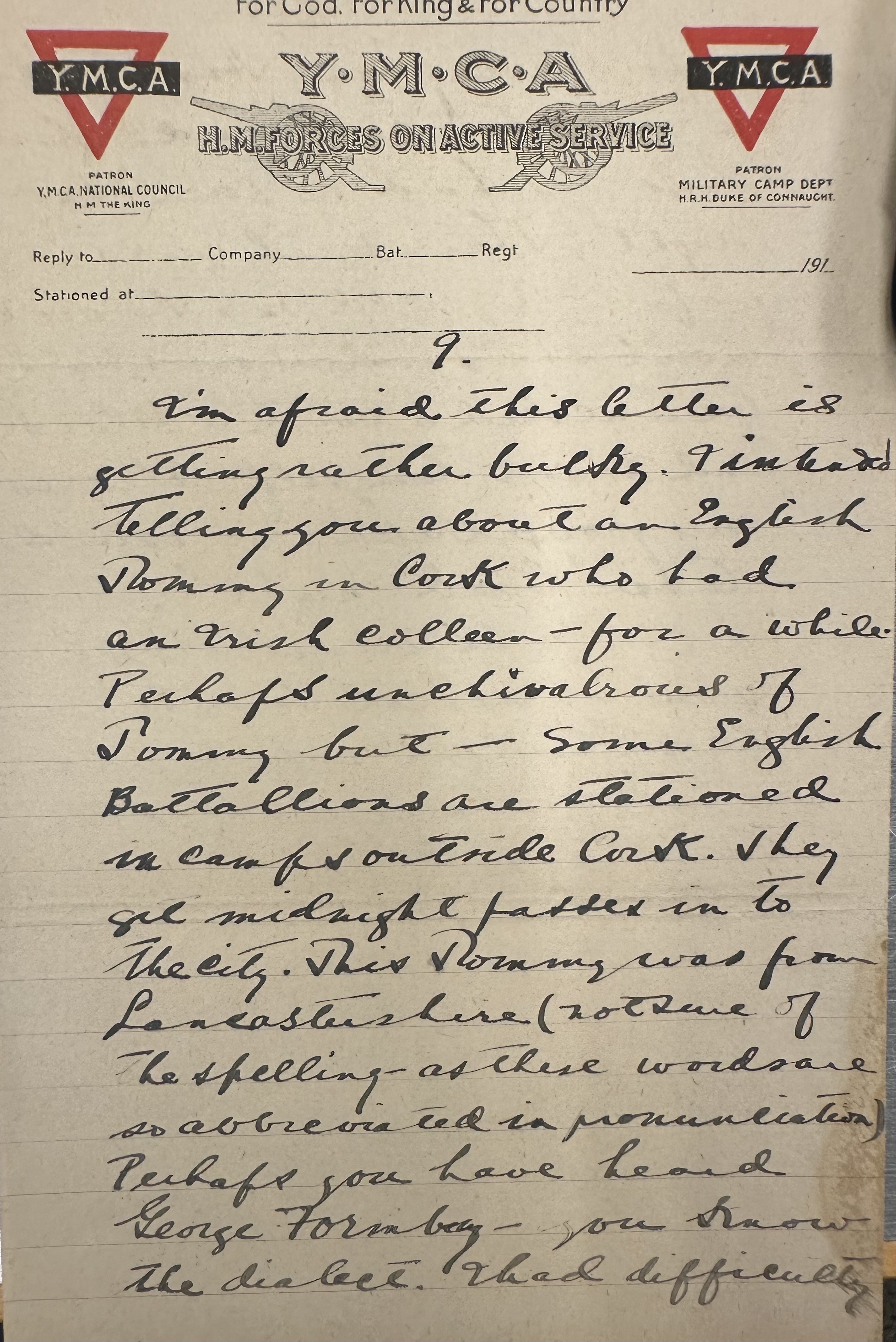
(pg 9) I’m afraid this letter is getting rather bulky. I’m hard telling you about an English Tommy in Cork who had an Irish colleen – for a while. Perhaps unchivalrous of Tommy, but some English Battalions are stationed in camps outside Cork. They get midnight passes into the city. This Tommy was from Lancashire (not sure of the spelling – as these words are so abbreviated in pronunciation). Perhaps you have heard George Formby — you know the dialect. I had difficulty (pg 10) in following him. His speech in substance and English – thus – I had a “tart” tonight. These Irish girls are awful. “Wouldn’t make out now” she said. Wouldn’t. We walked about a block and said to myself – this is no good at all – so I said to her “good night”.
Well I must close now as I expect to go to Blighty tonight where I meet a pal – who journeyed to Edinburgh.
Very sincerely,
Hal.



Leave a comment