When I started Perspectives on the Front 2.0, I had the idea that I needed a section that changed regularly to make the blog “sticky.” My thought was to create a section highlighting some of the more interesting, unusual, intriguing and thought-provoking circumstances surrounding Canadian servicemen killed in the First World War, as found among the more than 112,000 pages of Circumstances of Death (CoD) Registers.
My review of the records was undertaken in conjunction with another project I’m working on—tracking deaths by suicide at the Front, something that I believe is woefully understudied in the context of suicide and the First World War. While reviewing 112,000 pages sounds like a huge undertaking, it actually went surprisingly quickly. You learn to focus on key words and terms—suicide, self-inflicted, shot himself, Court of Enquiry—rather than reading the detail . . . until you encounter one that commands your attention.
Returning to my blog, I had the idea that I would update these entries frequently to provide a steady stream of new content. Unfortunately, to date, I have lacked the discipline to maintain that momentum, compounded by my natural instinct to devote far too much time to trying to uncover more information about the individual rather than sticking to the original plan of simply posting the details from the register.
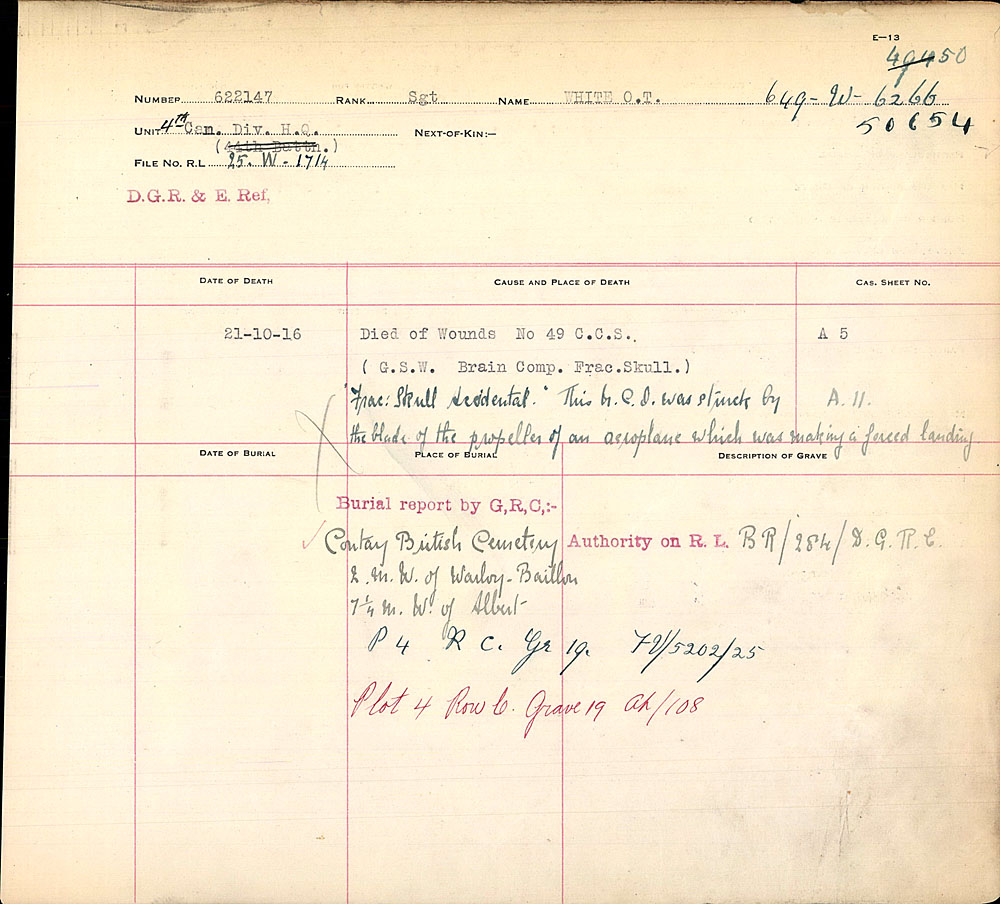
One of those entries was that of Sergeant Oscar Thomas White, who was killed on 21 October 1916 while serving with the 4th Canadian Division.
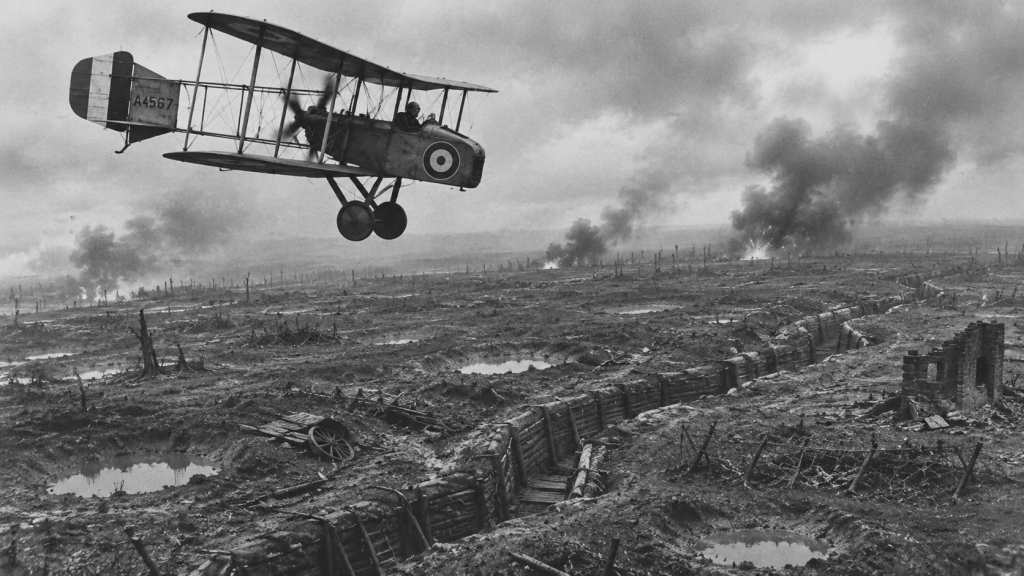
On reading the circumstances of his death –“Died of Wounds . . . struck by the blade of the propeller of an airplane which was making a forced landing”– I immediately wondered about the pilot and the aircraft, and what had brought the airplane down in the vicinity of 4th Division headquarters, where White was serving at the time.
I had no expectations – this would be like finding the proverbial needle in a haystack. Full transparency: I also used ChatGPT to gather and collate some basic information, which proved inordinately helpful in identifying and tracking down records that would be useful to the investigation. Having said that, ChatGPT can seem rigid and fixated at times, anchoring on a point that quickly proves incorrect and then repeating the information rather than eliminating it from the analysis. 1As an example, when culling a list of the squadrons operating in the region, ChatGPT placed excessive emphasis on two squadrons simply because they had been in an area where the 4th Division had been based prior to the Regina Trench engagement.
My first step was to compile all of the readily available online documents that referenced Oscar Thomas White and made mention of the accident: records from the Commonwealth War Graves Commission (CWGC), battalion and divisional war diaries, service records and other sources. My hope was that I could piece together what happened without having to go into the archives for documents that were not available online. These documents were valuable, confirming that the accident had occurred, but they also contained details that proved misleading and, in some cases, contradictory.
The diary of General David Watson, Commander of the 4th Division at the time, states that “one of our aeroplanes came down beside our office seriously injuring White . . .” The diaries of the 4th Division Assistant Adjutant and Quartermaster General similarly noted that “one of our Aeroplanes” made a “forced” landing at HQ, Tara Hill, striking a tent and fatally injuring White. The reference to “our aeroplanes” contrasted with references in White’s service record, which described the aircraft as either a French aircraft or a “British Aeroplane, piloted by a French aviator.”
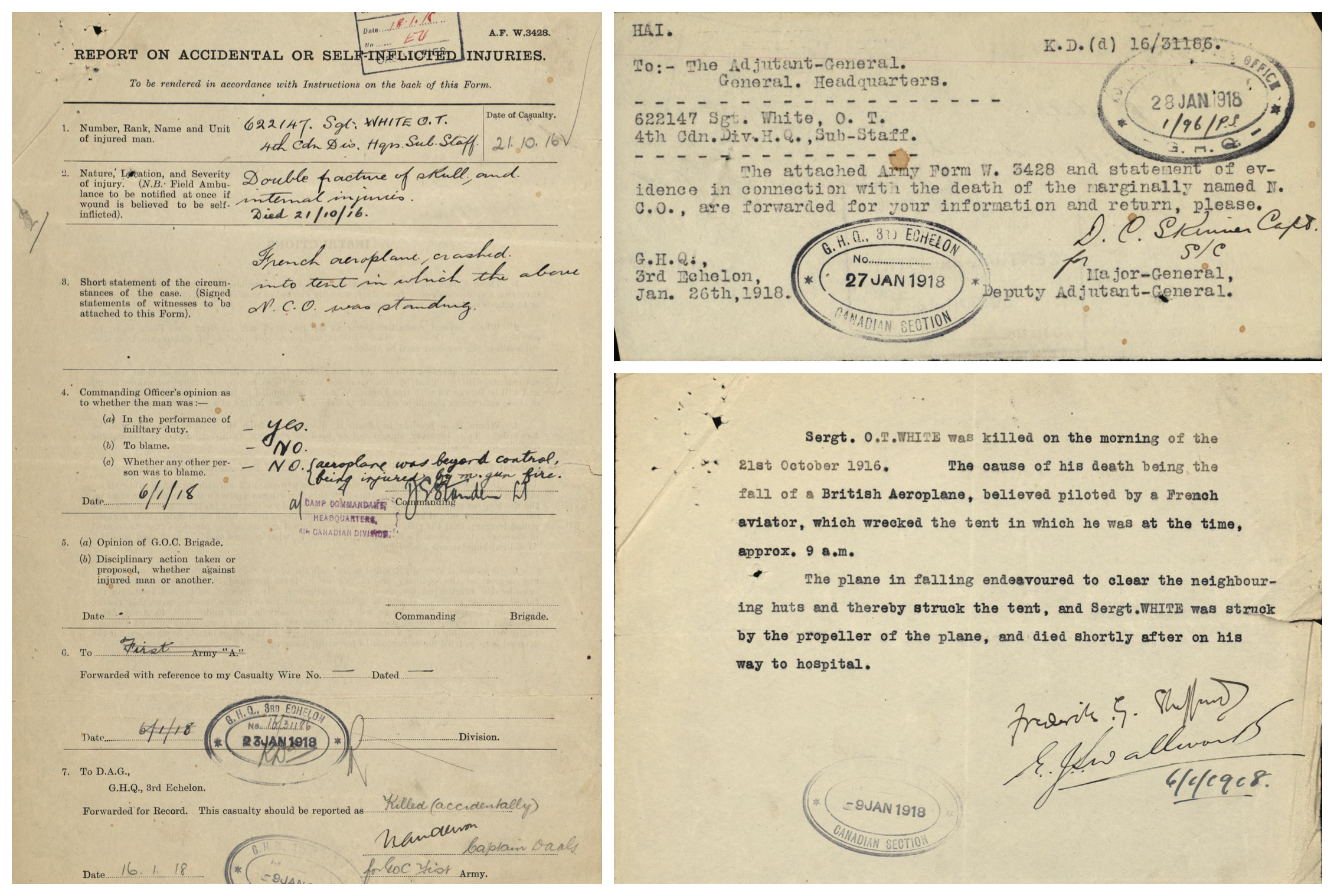
The references to the French proved to be distracting red herrings, resulting in brief searches of French records and British records for references to French pilots. Both proved fruitless. Exchanges between British and French pilots did take place—for example, Leonard Learmount of No. 7 Squadron was sent to the French Bombardment Group at Malzéville in March 1916 to study French night-bombing techniques—but broader searches turned up nothing, and the available references suggested that such exchanges were rare or non-existent.
The immediate tasks, therefore, were:
- to identify the location of the 4th Canadian Division on 21 October;
- to identify the squadrons operating in that vicinity or supporting the Regina Trench action; and
- to examine the records of the Royal Flying Corps (RFC) for references to crashes or damaged aircraft on 21 October.
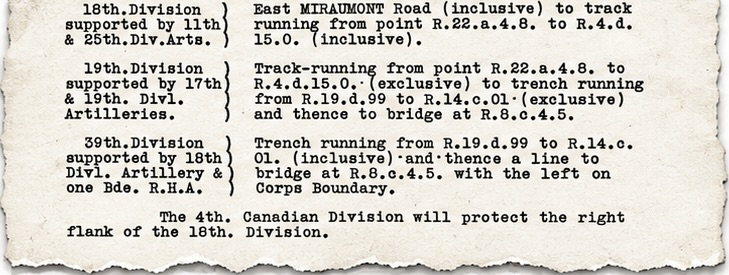
Based on references in the 4th Division’s operational orders for the attack on Regina Trench, I initially placed the 4th Canadian Division on the right flank of the 18th Division, east of Miraumont Road. With the 4th Canadian Division located in the vicinity of Warloy at the time of the accident, I used ChatGPT to compile a list of British squadrons potentially operating in the area.
This narrowed the search to three:
- No. 7 Squadron, because it was at Warloy-Baillon and the movements of the Canadian Division headquarters and General Watson made it potentially relevant;
- No. 11 Squadron, an FE2b squadron that was involved in escort and bombing operations on 21 October and had incurred casualties that day; and
- No. 18 Squadron, which was operating FE2bs in the Somme sector and was potentially involved in reconnaissance and artillery cooperation.
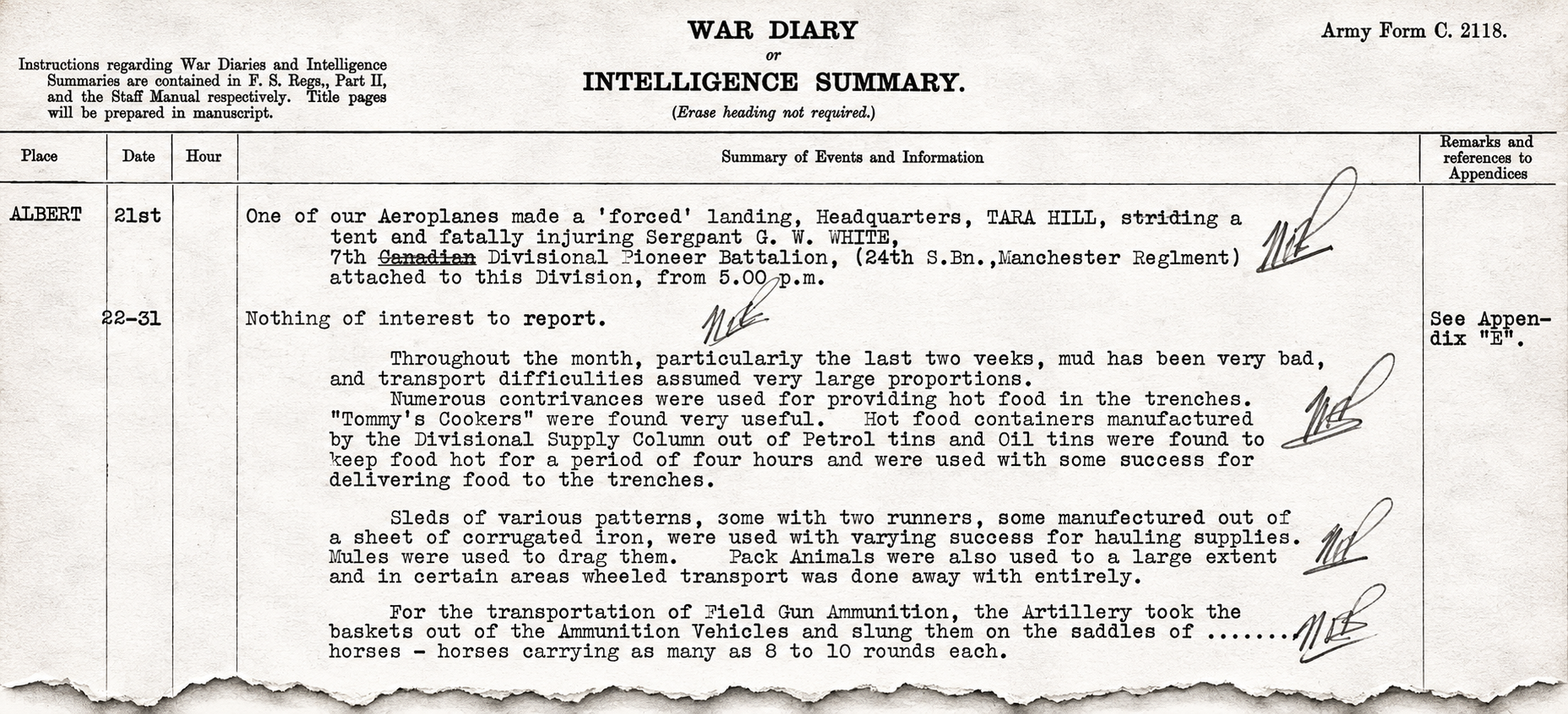
A review of the diary of the 4th Division Staff H.Q. (Assistant Adjutant and Quartermaster-General) however, showed that the Division had two operating locations: Tara Hill and Warloy. This was an important adjustment, as it broadened the geographical area that needed to be considered when determining which aircraft might have been operating in support of the Division.
One squadron that did not appear in this initial assessment was No. 24 Squadron, which was based at Bertangles and operating in the Somme sector. In retrospect, its omission was influenced by my reliance on information from ChatGPT.
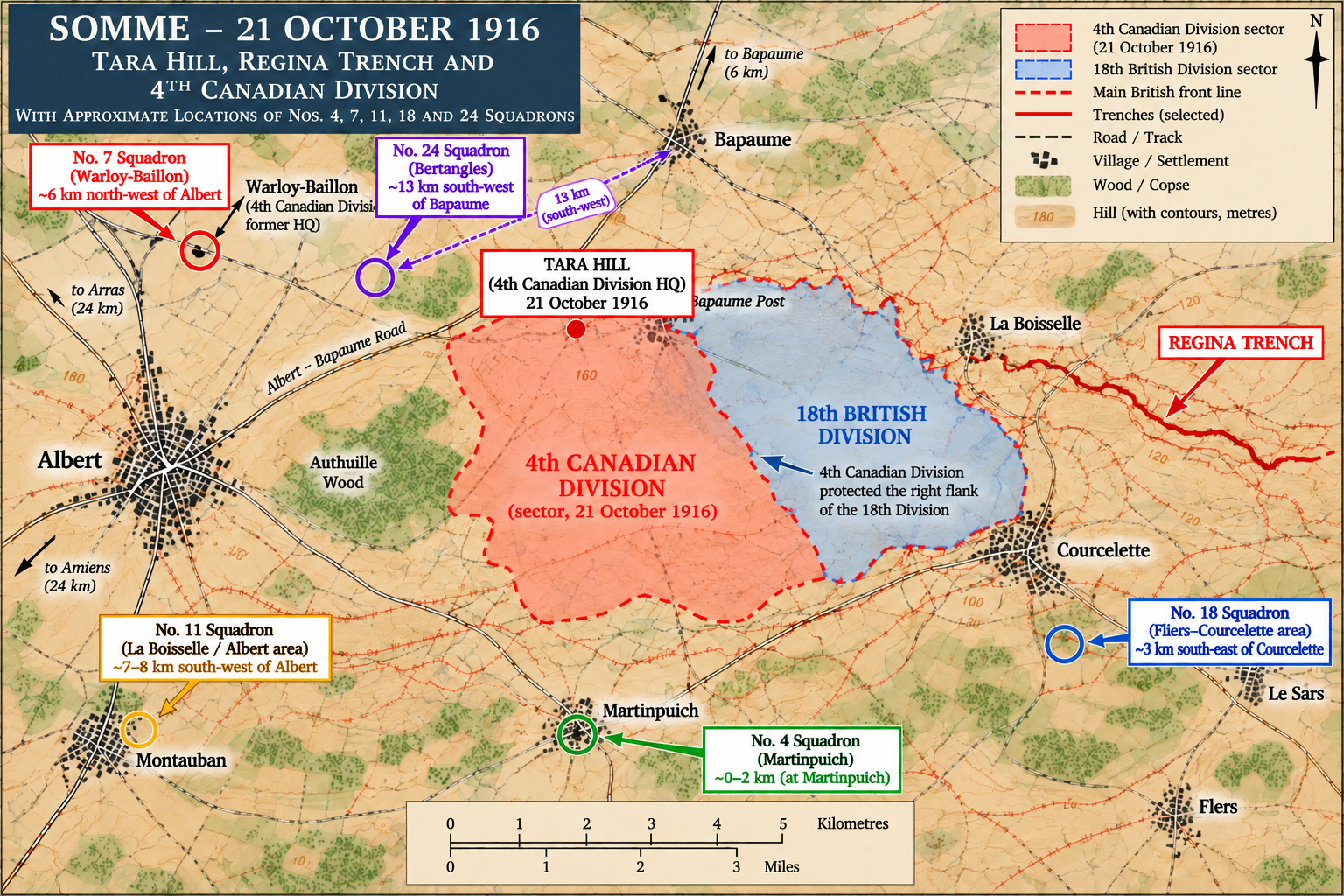
The data from ChatGPT had also placed considerable emphasis on the type of aircraft that might have been operating in the area and involved in the accident—something to which I did not pay close enough attention at the time. The primary focus, therefore, became reconnaissance and observation aircraft, which—rightly or wrongly—I concluded routinely operated around headquarters and artillery positions. On this assumption, the likely candidates for an accident in the vicinity of 4th Division headquarters were BE2s, FE2s and similar two-seaters used for reconnaissance, artillery observation and infantry cooperation, rather than fighters such as the DH.2. Since No. 24 Squadron’s primary role was fighter operations, it did not initially appear to be a likely candidate.
The RFC crash reports then became critical in identifying or ruling out aircraft that might have been involved in the accident that killed White. A few Internet searches turned up a blog, airhistory.org, that covers the history of the RFC from 1912 to 1918 and, notably, includes details on the RFC and its aircraft: listings of personnel, aircraft logs, squadron records, damage reports (struck off strength), casualty reports, and much more. I narrowed the date range to 20–25 October, allowing for possible discrepancies in the recorded date, and focused on squadrons I believed were operating in the region of Warloy and the Canadian H.Q., were active on the 21st, or were supporting the Regina Trench attack.
Even after identifying Tara Hill as a secondary location for the 4th Division – and the location of the crash, there were again some red herrings—and, more significantly, an omission on my part. The RFC records listed four deaths on 21 October, although there was nothing to suggest that the pilot involved in the White accident had been killed, and the circumstances of those deaths appeared to exclude them as possible matches. Private William Banks of No. 7 Squadron, for example, was a mechanic and would not have been flying. Similarly, 2nd Lt. P. C. Garrett of No. 70 Squadron (a Canadian) was wounded in a crash on the 21st. His squadron, however, was operating a considerable distance from Regina Trench and therefore seemed unlikely to have been involved. A newspaper account also described Garrett’s accident as a collision with another aircraft. More importantly, I failed to make the connection between Tara Hill and an entry in the RFC records describing an aircraft flown by 2/Lt. W. E. Nixon that had gone down there.
Notably, crash reports and casualty reports were two very different data sets. While an incident could still appear in the Casualty Book if one of the RFC airmen was injured their aircraft might not appear in the crash reports if the aircraft itself was not damaged or destroyed.
To this point, I was relying heavily on feedback from ChatGPT, while providing probing questions and prompts. ChatGPT continued to return data about No. 7 Squadron as the most likely candidate until I specifically broadened the search to any aircraft operating in the vicinity. That broader approach was like a lightbulb going off for ChatGPT. The search expanded beyond the squadrons and aircraft that had initially been identified as likely candidates.
Although I had already identified Tara Hill as a secondary location for the 4th Division, I failed to make the connection to an RFC record describing an accident there on 21 October. It was only when I broadened the search beyond the squadrons and aircraft I had initially identified that the significance of the record became apparent.
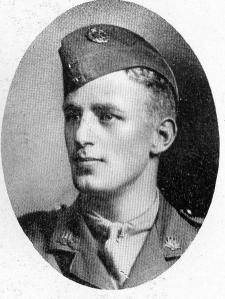
The accident involved a BE2c from No. 24 Squadron, piloted by 2nd Lt. W. E. Nixon, and was the first incident I had found that appeared to fit the circumstances of White’s death. At this point, my investigation had a specific aircraft and pilot to focus on. At the same time, however, for context, I was also interested in all aircraft that might have been supporting the Regina Trench operation on the 21st, and in what was happening operationally around Tara Hill and Regina Trench that day.
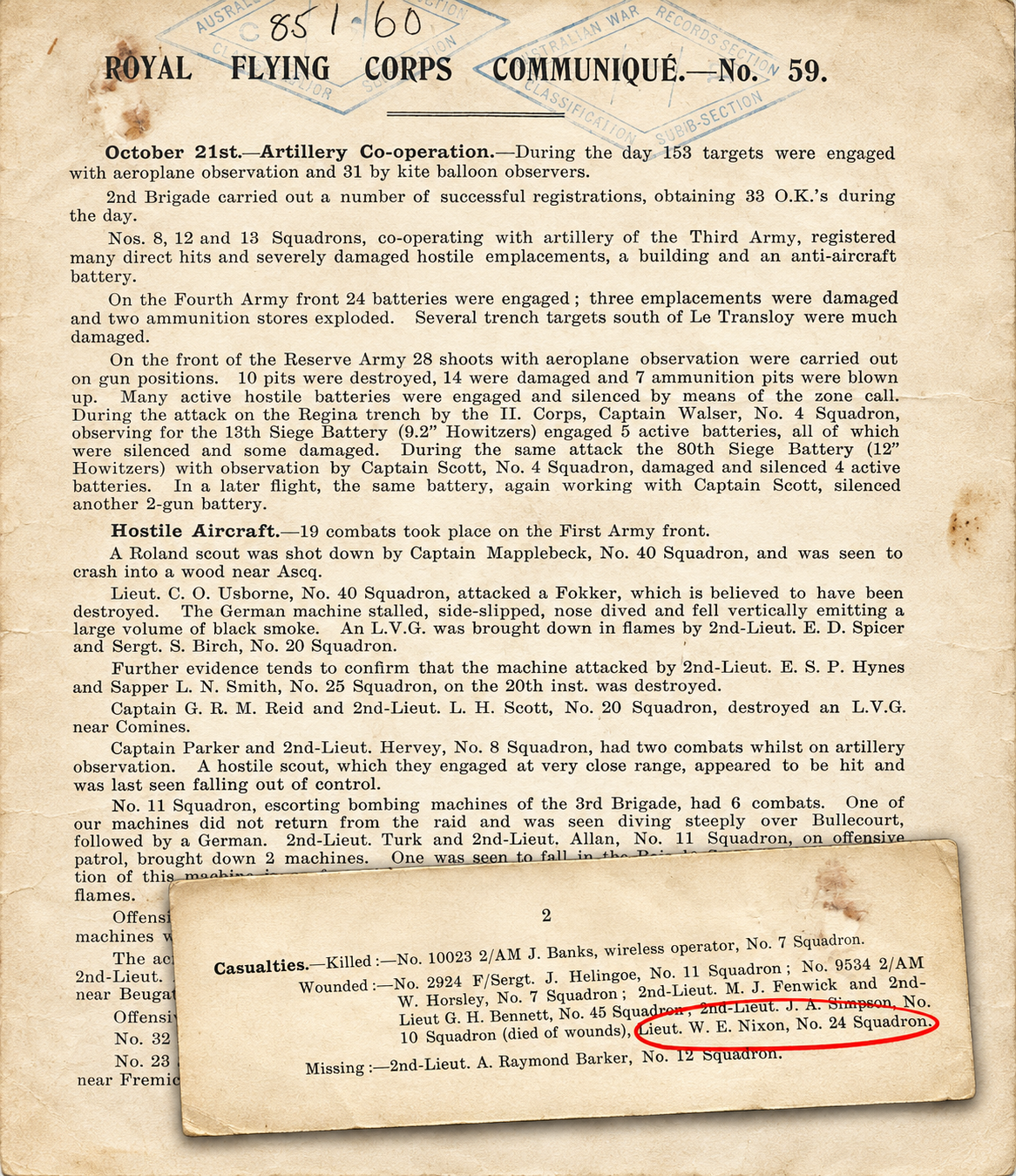
For this, I looked for a Royal Flying Corps Communique – a daily operational report issued by the Royal Flying Corps. RFC Communique No. 59 specifically covers RFC operations on 21 October 1916. The Australian Government has made a number of RFC communiques available online, including No. 59, which confirmed the sorties flown in support of the Regina Trench operation and the wounding of 2nd Lt. Nixon.
Rounding out the research and looking for additional information on Lt. Nixon, I consulted the Great War Forum and uncovered a brief discussion centred on Nixon and subsequent crashes in September and October 1916. The discussion also included a photograph, likely mislabelled, of a partial propeller from Nixon’s aircraft. My hypothesis connecting Nixon and White was further supported by a member of the forum, who confirmed that Nixon had headed out on an offensive patrol at 6:00 a.m., but approximately three hours later his engine failed as he turned to land. The aircraft stalled and crashed into a trench at Tara Hill.
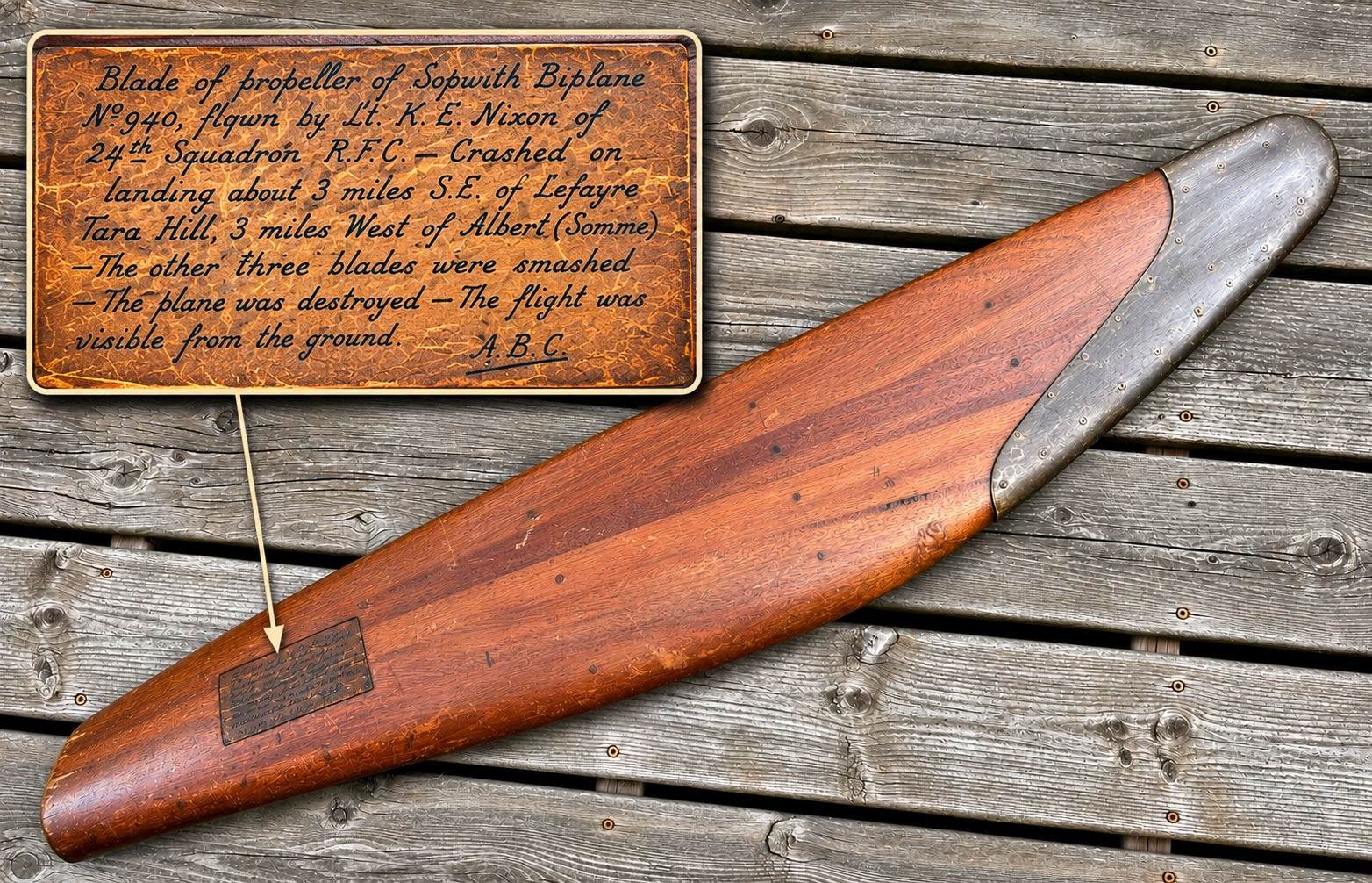
With this evidence pointing to Nixon’s aircraft crash landing on a tent at Tara Hill, a short distance northeast of Albert (Sh.57d W.24.), I was fairly certain that I had identified both the pilot and the aircraft involved in the accident that killed Sergeant Oscar Thomas White. At approximately 9:00 a.m., Nixon’s aircraft was hit by machine-gun fire. While out of control, he was able to avoid the huts of 4th Division, but crash landed on the tent in which White was standing. The aircraft’s propeller struck White in the head, fracturing his skull, and he died on the way to Casualty Clearing Station No. 49.
Behind the lines in a rear support area rather than the front-line trench system, standing in his tent, Sergeant Oscar Thomas White was killed not by machine gun fire or shrapnel from artillery, but by an entirely random event – a falling aircraft. His death was ruled an accident.
- ChatGPT is a particularly useful tool for an analysis like this, as an example, for locating useful resources, providing simple context of events, confirming details and identifying relevant information such as the squadrons that were operating in the area, in the case of the White story. At the same time, it is just a tool and the information is often incorrect. I have repeatedly challenged information that was returned to me and found it to be wrong. In the words of ChatGPT when I challenged its “fixation” with No. 7 Squadron:
“You’re right to challenge that. I narrowed onto No. 7 too quickly, largely because White was killed at Warloy and No. 7 was based at Warloy-Baillon. That is a useful clue, but it is not sufficient reason to make No. 7 the primary candidate” ↩︎



Leave a Reply